// Neurosymbolic & Quantic NFTs
Neurosymb Oracles
NSO Core Vague 1
Sympy is a Python library that allows you to do precise, symbolic mathematics.
Instead of using an approximate mathematical expression (ex. 3.14159), it will use the exact symbol (𝝅).It is therefore a useful tool for:- Processing mathematical expressions with ease: it can simplify them (eg. ((x2 + 2x + 1)) becomes ((x + 1)2)).- Solving equations: Find the roots of a polynomial, solve systems of linear or differential equations.- Doing differential and integral calculations: Calculate derivatives, integrals, or limits.- Working with matrices and linear algebra: Invert a matrix, calculate determinants, etc.- Generating LaTeX code: To display mathematical formulas in a clear, professional and elegant way.PyTorch is also an open-source Python software library, developed primarily by Meta.It was designed to facilitate the development of artificial intelligence (AI) programs, particularly in the area of machine learning and deep learning.PyTorch is essential for:- Training AI models:Due to its flexibility and speed of iteration, its role is that of a learning engine, made to create and develop neural networks.This can for example concern images with the aim of identifying an object or a being.
It can inject 10,000 photos of cats so that an AI model knows how to recognize them instantly by memorizing a multitude of micro-details.
Depending on the objective entrusted to him, and according to the same principle, he can use text if his "apprentice" is intended to become a chatbot, or in another case the creation of content (images, text, music).It arranges large sets of data in tensors, these are multidimensional tables or matrices, this mode of organization facilitates the encoding of data input and output flows as well as operations on the parameters of the model to be trained.
And once it has reached the required level of excellence, it will be ready to predict results.- Assimilating masses of complex data: Such as images, videos, sound or text, digital data, and extract all the useful information to draw conclusions and make predictions
1. PyTorch's Contribution to the Artifact (The Organic Brain)As a deep learning engine, we imagine PyTorch, taking care of the concretization, the visual, textured and intuitive aspect of the work.Function: The PyTorch part after having been trained using an enormous amount of complex data, or to generate images based on latent spaces, its impulse will be to seek to execute the work by reproducing a learned artistic style, fighting against the imperfections of the material, adjusting its gesture according to what it observes, it adapts empirically, it faces the reality of the creation while Sympy remains rooted in ethereal artistic inspiration.
This is the fuzzy, impulsive, emotional part.
Calculating with floating point, approximation factor, opening the breach to unpredictability, which increases the probability of an hallucination occurring, in this accomplished, neurosymbolic bicameral artist.One could imagine its own artistic contribution as a series of point clouds or color fields that blend into each other, creating a highly dynamic atmosphere including rich textures, subtle color gradients, and organic shapes that could resemble smoke, cells, abstract landscapes or vague and fleeting faces, reminiscences of past trainings.2. The Contribution of SymPy (The Logical Structure)SymPy as a symbolic mathematics and logic engine, represents rigor, order.
He would be responsible for the reason for the work, the perfect geometric plan for its creation with exact proportions calculated and traced in an ideal way, according to strict and pure mathematical rules, from precise equations, he would be the pilot, the architect.We imagine clear lines of force, grids, precise geometric shapes, perfect circles, squares, mathematical spirals, or textual/symbolic annotations such as variables, simplified equations.The SymPy personality of Neurosymbolic synergy would correct, frame or define the rules for the output of PyTorch.
For example, if PyTorch generated point clouds, SymPy could authoritatively dictate that these points should align along a Bézier curve or should never cross a certain boundary defined by an equation (like y=x^2).We visualize wireframe structures or geometric diagrams which seem to "analyze" or "master" the uncertain, imprecise and therefore perceived imperfect textures, generated by PyTorch.3. Neurosymbolic Fusion: The Final ResultThe final artifact would be a visual dialogue between these two distinct worlds:Let's imagine an abstract oil painting conceived in the bubbling intensity of PyTorch which would then have been cut up, reassembled, or annotated by a master craftsman with an inflexible requirement SymPy.The organic textures of PyTorch would give gush, depth and emotion.The lines of SymPy would produce meaning, constraint and intelligence.The expected result of the union of these two forces would be a work that would seem to "think": it would be visually beautiful, but its patterns, its structure or its contours would obey a mathematical or logical rule hidden but revealed by the work in its materiality.Taken separately neither Pytorch nor Sympy are gifted in the literal sense of reason, but their joint action, in synergy, creates a fascinating and disturbing form of hybrid cognition.
Together, although opposed in different aspects, they do not confront each other;
they converge to define a new form of artistic inspiration, of generative art, making an artifact that reasons sensitive.Pytorch is the empirical intuition:- It discovers patterns in data streams without being told what to look for- It adapts, generalizes, makes predictions from the information resources provided to it- It works by statistical “sensation” like our intuition- There remains a black box, it is difficult for him to explain why it worksSympy is the rational formalization:- It translates into rigorous mathematical language- It checks logical consistency, if the processed formula respects the known theoretical constraints otherwise Pytorch relearns with these integrated constraints and the loop repeats until convergence- It makes explicit and communicable what was implicit- He cannot discover anything by himself
We see that intuition and formalization come together under a new Neurosymbolic entity which reasons by combining theory and observation as a scientist would do in his research work.Level 1: Inductive reasoning (from particular to general)Pytorch observes repetitive signals and patterns in a large volume of data and will conclude and induce a general ruleLevel 2: Deductive reasoning (from general to specific)Sympy takes a general formula and will deduce specific cases from itLevel 3: Abductive reasoning: the best explanationThe hybrid will look for the simplest formula that will explain the data (principle of scientific parsimony)Level 4: Analogical reasoningThe pooling of the two systems allows the transfer of structures learned in one system and their use in anotherLevel 5: MetareasoningThe union of the two systems will evaluate the quality of its predictions and formulas, and will decide whether it needs more data or whether it would be better to apply a better theory.It is a distributed cognition where neural statistical intuition meets logical and symbolic rigor.
Empirical learning joins formal theory, discovery finds its explanation.And that's exactly how our brain works.
The right hemisphere (intuitive, pattern matching, Pytorch) and the left hemisphere (logical, rational) which collaborate to create our conscious experience of reasoning.
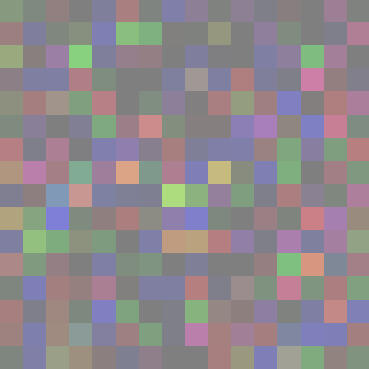
Neurosymbol Oracle #1 Hero
**The work is structured according to a regular orthonormal grid composed of square modules of uniform size.
Each module constitutes an autonomous chromatic unit, defined by subtle but perceptible variations in hue, saturation and brightness.
The spectrum depicted oscillates primarily between desaturated greens, cool purples, muted pinks and a wide range of colorful grays.From a plastic point of view, the piece brings into play a serial logic close to the first algorithmic experiments of the 1960s–1970s.
The distribution of colors seems to arise from a stochastic protocol: the chromatic values appear distributed according to a pseudo-random pattern which prohibits any repetitive pattern or clear visual hierarchy.
The composition thus produces an isotropic field, without center or privileged direction, of great beauty, inviting a non-linear reading.The absence of smooth transitions – each cell being clearly delimited by its implicit grid outline – gives the whole thing a granularity typical of low-resolution digital environments.
This granularity, by making visible the minimal unity of the image, brings about a reversal: what, in modern visual systems, is normally destined to disappear (the pixel), here becomes the raw material of the artistic gesture.The work is therefore part of a lineage ranging from geometric abstraction to generative art, mobilizing principles of spatial subdivision, modular independence and chromatic equivalence.
It lays bare the very structure of the digital image, revealing how the colorful combination of elementary units can constitute an autonomous and rigorous plastic vocabulary.The NFT “reasons” thanks to SymPy, because it solves personalized logical puzzles, such as ethical or aesthetic equations.
For example, Oracle #1 Hero as you can see in the previous section calculates [3 - sqrt(33)xI, 3 sqrt(33)xI], forcing art to obey an inexorable mathematical truth.
Removing chaos.With PyTorch, your NFT “predicts” aligned outcomes: its neural network generates visual shapes that respect integrated ethical rules, avoiding disorder.
This is a step towards aligned AI – it’s art that predicts harmony, not disorder!”These NFTs are “living”: they evolve with the blockchain!
Change ownership, and the art is transformed (e.g. new, more intense colors via SymPy on 5th resale).
It is an artifact that is not fixed, it increases its brilliance at the 5th stage of its journey in the digital eternity of the blockchain!”This "Wave 1" series was generated by an HP laptop with a Pentium N3710 @1.6 GHZ processor and 4 GB of RAM, an IGP graphics card, running Ubuntu 22.04.2 & Python 3.10A GPU-free feat accomplished with very low carbon impact (BytesIO)
Liste de diffusion
If you would like to be kept informed in advance of our next events, NFT launches or receive exclusive informations on other projects?
So please do enter your details opposite in the form and you won't miss a thing.Important information on the protection of your data: By registering, you acknowledge that your email address will only be used for sending our newsletters and various information concerning our upcoming projects.
You can unsubscribe at any time via the unsubscribe link in each email.
For more details on the management of your data and your rights (access, rectification, deletion), please consult our Confidentiality Policy at the end of this page.
This site is protected by reCAPTCHA which is a service owned by Google Google Privacy Policy and Google Terms of Service
1. Disclaimers⚠️ Disclaimer – Educational and Artistic ProjectThis project, including the collection of NFTs "NeuroSymbolic Artifacts", is for educational and artistic purposes.
It constitutes neither financial advice nor an investment recommendation.- Risks associated with NFTs: NFTs are volatile and speculative assets.
Their value may fluctuate or cancel each other out.
No guarantee of performance or resale is offered.- Sales "As is": NFTs are sold "AS-IS" (as is), without explicit or implicit warranty.
The buyer assumes all risks associated with their acquisition and use.- Tax obligations: Income generated from the sale or resale of NFTs may be taxable.
It is the buyer's responsibility to declare their income in accordance with their country's laws.- Limited liability: The creators of the project decline all responsibility in the event of financial, technical or other loss linked to the use of NFTs or the site.2. Privacy Policy and Use of Data (GDPR)🔒 Privacy PolicyIn accordance with the General Data Protection Regulation (GDPR), we are committed to protecting your personal data.
Here's how we handle them:Data CollectedWe collect only the following information via our Mailing List form (managed by Mailchimp Mailchimp GDPR:- Name (optional)
- E-mail addressPurpose of DataYour data is used exclusively for:- Send you artistic and educational updates related to the project (newsletter).- Inform you of events or updates of the NeuroSymbolic Artifacts.Data Protection- No sale or sharing: Your data will never be sold, exchanged, or communicated to third parties for commercial or other purposes.- Security: We use reCAPTCHA to protect the form against abuse, and Mailchimp (GDPR compliant) to manage subscriptions.- Retention period: Your data is kept until you unsubscribe or request its deletion.Your RightsIn accordance with the GDPR, you have the following rights:- Access: Request a copy of the data concerning you.- Rectification: Correct or update your information.- Deletion: Request erasure of your data.- Opposition: Unsubscribe at any time via the link in each email, or by contacting us.To exercise these rights, send an email to: [email protected].Cookies and TrackingThis site does not use any advertising tracking cookies.
Only technical cookies necessary for the operation of the site (via Carrd.co) are used.3. Legal Notices (Footer or Dedicated Page)⚖️ Legal Notices- Publisher: Neurosymboloracles- Contact: [email protected]- Hosting: Carrd.co Privacy Policy.- Intellectual property: All content (texts, images, codes) are protected by copyright.
Any unauthorized reproduction is prohibited.- Applicable law: These clauses are governed by French law.
© 2025 NeuroSymbolOracles | Educational/Artistic Project
Disclaimer | Privacy Policy | Legal Notices
Contact : contact
We use cookies to improve your experience. By continuing, you agree to our privacy policy